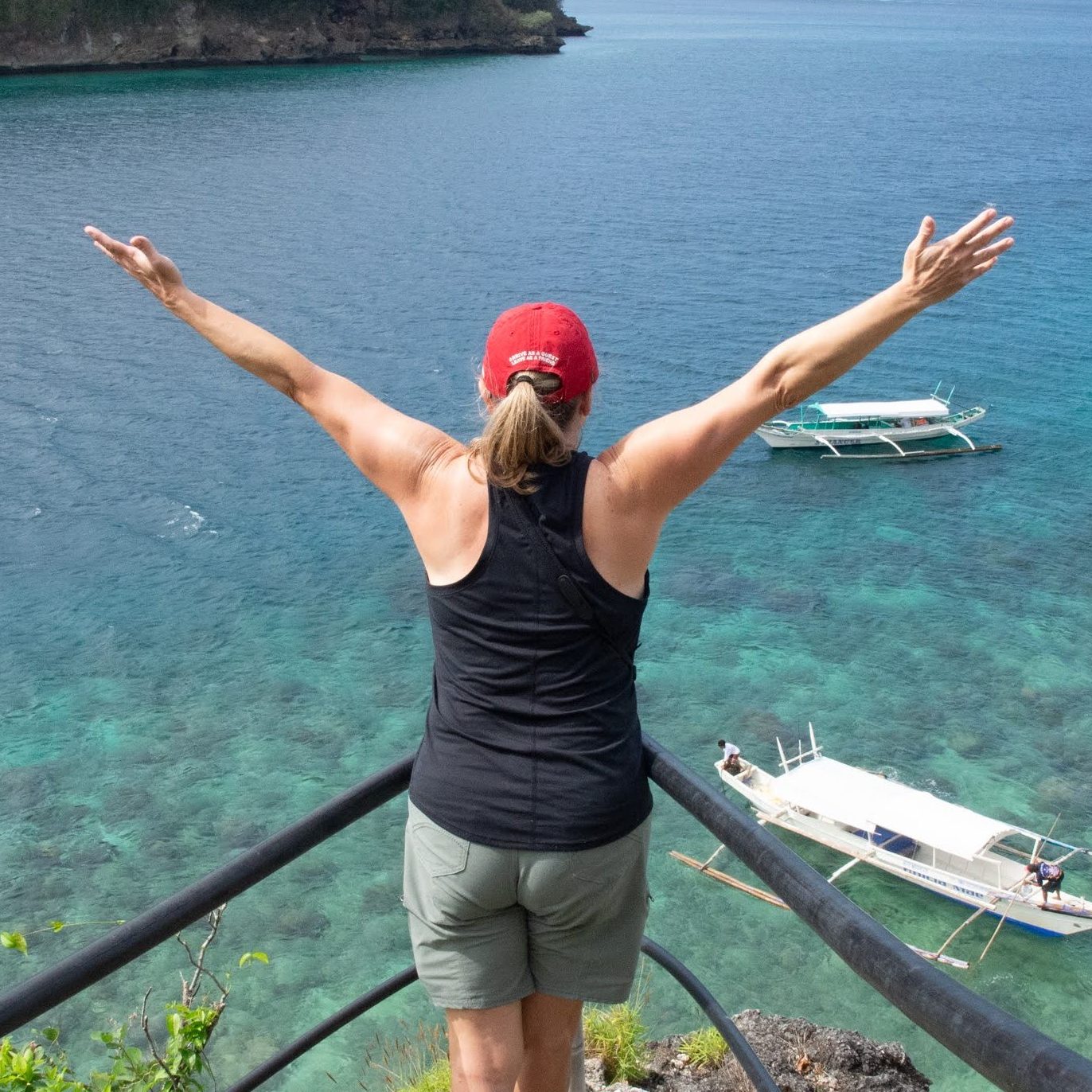
In April of 2024, I asked my new friend, Sue, if she was interested in going on a dive trip. As luck would have it, she had recently been approached by her friends, Maggi and Bruce, about an opportunity for a dive trip. The trip was to the Philippines and was a joint venture between the California Academy of Sciences and Seacology. Sue hadn’t committed because she didn’t have a dive buddy. Ummmm…sign me up please!
I’m not sure if I’ve mentioned that I went to Florida Atlantic University for a year during my undergrad. I wanted to be a marine biologist but instead, I moved back to Cincinnati with my future (and now former) husband and life took me in a different direction. However, I’ve always been drawn to the ocean and the critters within. I’m also passionate about environmental concerns and learning more about what I can do to support conservation efforts and counteract and/or slow down the effects of climate change. Well-traveled people have seen the effects of climate change firsthand, especially in delicate island communities. Reefs take up only 0.25% of the ocean’s surface area but account for 25% of the ocean’s marine biodiversity. Science has repeatedly and decisively proven the devastating and accelerating effects of human actions. Any remaining climate change deniers who are still burying their heads in the sand can jog on. Both Cal Academy and Seacology are involved in amazing work toward conservation efforts.

Dr. Terry Gosliner and Dr. Meg Burke were the trip leaders for the Cal Academy. Terry is the world’s top expert on nudibranchs (sea slugs with flair). He has identified and named hundreds of species since he first discovered his passion for these cute little critters in high school. He is the first author on the field guide for Nudibranch and Sea Slug Identification and Sea Slug Day is actually on his birthday in honor of him. Also, he has a hilarious sense of humor and is an absolute pleasure to be around. I was super starstruck to have the opportunity to dive with him and nerd out, but I tried not to ask too many dumb questions!
https://www.calacademy.org/learn-explore/scientist-spotlights/terry-gosliner


Meg’s background is equally impressive for the partnerships she has built with local communities, especially in the Philippines. While we were there, she and Terry had working meetings with local leaders. She is continuously learning from them about the threats of climate change, which often include pollution, overfishing, and mining. They collaborate on projects to build capacity and target forward-thinking conservation plans. Over the 30+ years that she has been visiting, she has gained a tremendous amount of trust, admiration, and respect from these people. How amazing it must be for her to see the difference that’s she’s made in these communities!


Seacology’s mission focuses on protecting the unique habitats and cultures of islands worldwide. They have over 400 projects in 70 countries and have protected over 1.5 million acres by finding “win-win” opportunities for the communities and their environments. We visited Tingloy one morning to see firsthand an example of their work. The problem was that during holidays and weekends, there is an influx of vacationers to their beautiful little beach who were leaving their waste and “waste” behind. In other words, there was no solution for trash collection and no bathrooms. This community benefits from ecotourism but the polluted beach was becoming a deterrent. Seacology listened to these concerns and built a bathroom in return for a protected area of beach and ocean. Seacology also weaves education into their programs so that residents and visitors better understand how their actions affect their environment and long-term success of their community.
More info on Seacology


So there’s the background. Now, on to the trip! Our destination was the Verde Island Passage in the middle of the Coral Triangle. In other words, we were heading to “the center of the center” of the richest marine biodiversity on the planet. We started out with a layover in LA before our 16-hour flight to Manila. We spent just one night in Manila at the lovely Dusit Thani hotel and then we took a quick domestic flight to Cebu. After landing in Cebu, we had a 4 hour car ride to travel just 60 miles to Moalboal. My god, the traffic! And the power lines!


We settled into Turtle Bay Dive Resort and snorkeled a little with the Green Turtles in the bay before planning our next day. We got a recommendation from the bartender for a guy who would give us a ride to Inambakan Falls.


We met our driver, Alfie, the next morning but to our surprise, he rolled up on a scooter (think Vespa) and handed us very worn, kid-sized Styrofoam bike helmets. Sue and I looked at each other and said okey-dokey, let’s go! Sue was in the middle and I held on tight in the back. We had a 2 hour ride! About a half hour in, he pulled over to the side and his cousin joined us with a second scooter. Much better – right?? After a half hour with his cousin, our back tire blew while going around 35 mph and we fishtailed for about 30 yards to a stop. Fuck! That could have gone seriously wrong if my excellent driver had lost control but thankfully, he was very skilled and kept me safe. Alfie and Sue circled back and we were back to 3 on Alfie’s bike for the next hour.


The view from the Falls was gorgeous! There are several falls on Cebu island but Inambakan Falls is less touristy than others so we stood out with our light skin and hair and were treated a little like celebrities. We met a group of 20-somethings who were hanging out while their fish was frying on a fire. We were also interviewed by a group of students who were studying Hospitality at the local college. I was beginning to understand why visitors say Filipinos are so friendly and welcoming.


After the falls, we hopped back on the bikes and journeyed back to Turtle Bay without incident. The next day we relaxed and then re-traced our steps back to the Dusit Thani in Manila to meet our group and work our way towards our next adventure.
Our home for the next 5 days was Buceo Anilao Dive Resort in Batangas, which turned out to be my favorite resort during our time in the Philippines. Dave, the owner, welcomed us and knew everyone’s name by the next day. Our Divemasters, JohnLloyd and Enzo, were superb and so much fun. The rest of the staff was so kind and accommodating, including the little tree snake who patrolled our bathroom for critters. We watched colorful Olive-backed Sunbirds flit among the flowers. And the MANGOS!! My god, the mangos!!


We started each day with a breakfast buffet and then were briefed by our Divemasters for the day’s dives. Daily dives were 8:00, 10:00, 3:00, and 5:30. Our dive boats were bangkas – super stable, easy exit boats where you just roll backwards off the boat into the water. They are low enough that you take off your equipment after the dive while still in the water and the Captain pulls it onto the boat for you. I didn’t have to stand with my heavy equipment the entire trip! My back was thankful!


Here is where we were and an example of our plan for the day.


And the DIVING!!! The healthiest reefs I’ve ever seen and so diverse! Here are some pictures from our time in the Batangas. The vast majority of these were taken by my fellow travelers with their fancy cameras. My little GoPro doesn’t due justice to the incredible colors underwater so I can’t take credit for these, but am very thankful that they shared theirs. (Photo credits to Terry, Meg, Joe C, Bruce, and Lois)
Barracudas, giant clam, lots of morays, clownfish protecting their anemone homes, and weird alien frogfish.


To give some context regarding size, the pygmy seahorse below is only about a half inch! The sea turtles we saw were 3.5-4.5 feet long. The morays were 2-3 feet long. Orangutan crabs, Emperor Shrimp and the various other little shellfish were 0.25 – 1 inch long. The big, beautiful Peacock Mantis Shrimp (like lobsters without claws) were around 6 inches long. The cuttlefish was over a foot long.


Peacock Mantis Shrimp and spearing mantis shrimp burrowed in their holes waiting to ambush an unsuspecting fish (or diver’s finger), Emperor Shrimp, Orangutan Crabs and other crabs with grumpy faces, filefish, baby lobsters with long white antennae, garnards, and so many others!


And the nudibranchs!!! STUNNING! They were anywhere from 0.5 to 6 inches long.


Above water, we spent some time cleaning up the beach in front of Buceo Anilao. With nowhere to go, trash collects everywhere in the Philippines. Unfortunately, although it felt good to give the beach a temporary reprieve, we were told that the next typhoon would likely wash it all from the trash containers back to the shore. The result of Spanish missionaries forcing Catholicism onto Filipinos in the 16th century is overpopulation, straining the country’s resources and leaving many people in poverty. Despite this, they value their education and it was very noticeable that the areas around their schools were free from trash and well-maintained. Just like at home in the States, it will likely be up to the younger generations to fix the problems created by my generation and before, but organizations like Cal Academy and Seacology are making great strides in the right direction.


We also saw firsthand the effects of climate change and an increased number of destructive weather events. We visited a reef that had been wiped out by a typhoon after it was already stressed by rising ocean temperatures. Completely heartbreaking, especially after seeing amazingly diverse reefs brimming with life.
After an amazing experience at Buceo Anilao, we said our goodbyes and boarded a water taxi to Sabang on the island of Mindoro.


We were welcomed at Atlantis Dive Resort with a lechon feast.
Sabang is hopping with nightlife (and a fair share of sex workers) and we explored some cute little markets between dives. I also booked a massage at a local spot and paid only $10 for a full hour!


As superb as JohnLloyd and Enzo at Buceo Anilao were, James and Captain Lenard matched them. I even added my nitrox certification with James while I was there so that I could dive longer and feel better afterwards.


Our dive days were similar to our days at Buceo Anilao with the exception of some very strong current on a few days. We had opportunities to dive 5 times per day there – 9:00, 11:00, 2:00, 4:00, 6:00. I saw my first and second-ever octopuses here! I was really, really hoping to see at least one. The first one looked a little like a squishy basketball and scurried away quickly. I screamed in my mask with delight and then teared up and had to use my yoga breathing to calm down from the excitement. The second was a beautiful purple color and was hiding in a hole. Just incredible!
We also did a muck dive and saw 2 seahorses. Technically, the pygmy seahorse at Buceo Anilao was my first seahorse but these two were the first seahorses that I could actually see without readers! One was hanging onto a clump of seagrass with his tail. The other was swimming and grazing. Adorable!
Another first was a great big cuttlefish like the guy in the picture below. Super strange and just swam right on by without being bothered at all.


I love this picture below for many reasons…1) my dive buddy, Sue, 2) the photobomb by Nolan from Toledo, Ohio (just a coincidence – not with our group), and 3) Terry, King of the Nudibranchs, with his joyful smile doing what he loves and wearing a nudibranch shirt. 🙂 Plus, how amazing do I look in a wetsuit and a scuba-do rag??!

We took a day trip from Sabang to Puerto Galera and Medio Island. We saw a huge colony of flying foxes/giant fruit bats in Puerto Galera – hundreds of them! On Medio Island, a local group is working to preserve its natural resources and build it as a tourist destination to celebrate local flora and fauna. We hiked a mile or so up and down some steep hills but the views were incredible! We even saw a Philippine Serpent Eagle soaring above.


What an adventure we had! I’m so thankful to have experienced this beautiful country with this group of people. I logged 17 dives during this trip and I’ve fallen in love with the Philippines. I am hoping for the opportunity to explore more fascinating places with Cal Academy and Seacology! Here’s one last look at our dive home on Sabang.
Leave a Reply